
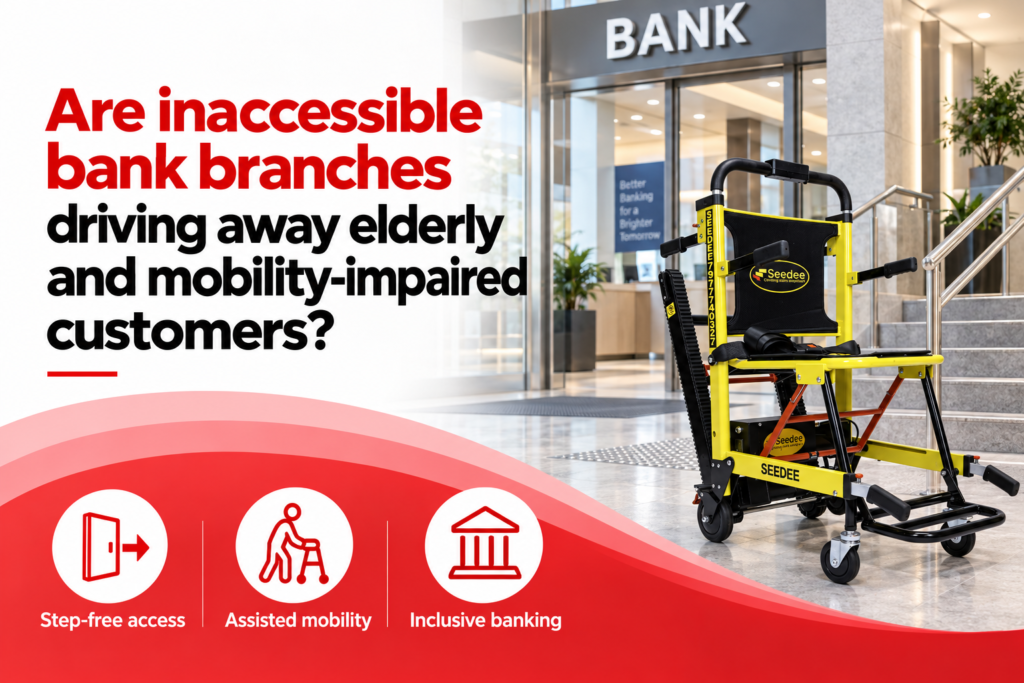
Think of a retired schoolteacher in a small town. She has banked at the same branch for nearly thirty years. Her pension arrives there, her fixed deposits are there, and the staff know her by name. But the branch sits on the first floor, above a row of shops, and the narrow staircase has grown a little harder to climb each year.
At first, she simply takes the stairs slowly. Then she begins waiting for her son to take a day off work so he can go with her. One day, a neighbour mentions that another bank has opened on the ground floor, just down the road. A few weeks later, she moves her account.
Nobody at her old branch ever finds out why she left.
This is not an unusual story. Across India, and especially in smaller cities and towns, many elderly and mobility-impaired customers are quietly drifting away from banks they can no longer comfortably enter. They rarely complain. They just stop coming.
India is growing older, and faster than we think
According to the India Ageing Report 2023 by UNFPA and the International Institute for Population Sciences, India had around 149 million people aged 60 and above in 2022, about 10.5 per cent of the population. By 2050, that number is projected to reach roughly 347 million, or about one in every five Indians. The number of people aged 80 and above is expected to grow even faster.
For banks, this is not a distant statistic. Older customers are often among the most loyal a branch has. They hold long-standing savings, pension accounts and deposits, and they influence where their children and grandchildren bank too. A branch that cannot welcome them through its door is slowly closing itself off from a growing part of its community.
What it feels like when you cannot get in
Accessibility is often discussed in terms of ramps and measurements. For the customer, though, it is mostly about dignity.
It is the discomfort of being half-carried up the stairs by two strangers. It is signing important documents while sitting on a step outside because the counter is out of reach. It is having to depend on a family member for something as personal as one’s own money. Over time, these small moments add up to a feeling of not being wanted.
When that happens, a customer does not usually raise a complaint. They look for a bank where they will not have to feel that way, and in a small town, word travels quickly.
What the RBI expects from banks
The Reserve Bank of India has long recognised this issue. Through its 2014 circulars on making bank branches and ATMs accessible to persons with disabilities, the RBI asked banks to take appropriate steps, including providing ramps at branch entrances wherever feasible, so that wheelchair users and persons with disabilities can enter and carry out their banking without difficulty. Branches are also expected to display a notice about the facilities available for customers with disabilities.
The same circulars accept that in some premises a ramp may simply not be practical, and allow the requirement to be set aside in such cases, with the reasons recorded and displayed. The Rights of Persons with Disabilities Act, 2016 further places accessibility at the centre of how public-facing services in India are expected to operate.
Here lies the gap. A ramp may be impractical for a building, but the customer’s need to get inside does not disappear along with it.



When a ramp or lift is not an option
Branch managers are rarely unwilling to help. More often, their hands are tied by the building itself:
- The premises are rented, and structural changes need the landlord’s permission.
- The entrance opens almost directly onto the road, leaving no room for a ramp. Even a gentle ramp for a handful of steps needs several metres of length.
- Installing a lift involves significant cost, civil work and approvals, which may not be justified for a small branch.
- The building is old, and the staircase is too narrow or too steep to modify safely.
In these situations, the question changes from “How do we rebuild the entrance?” to “How do we help this customer up the stairs safely and with dignity?”
How a wheelchair for stairs can bridge the gap
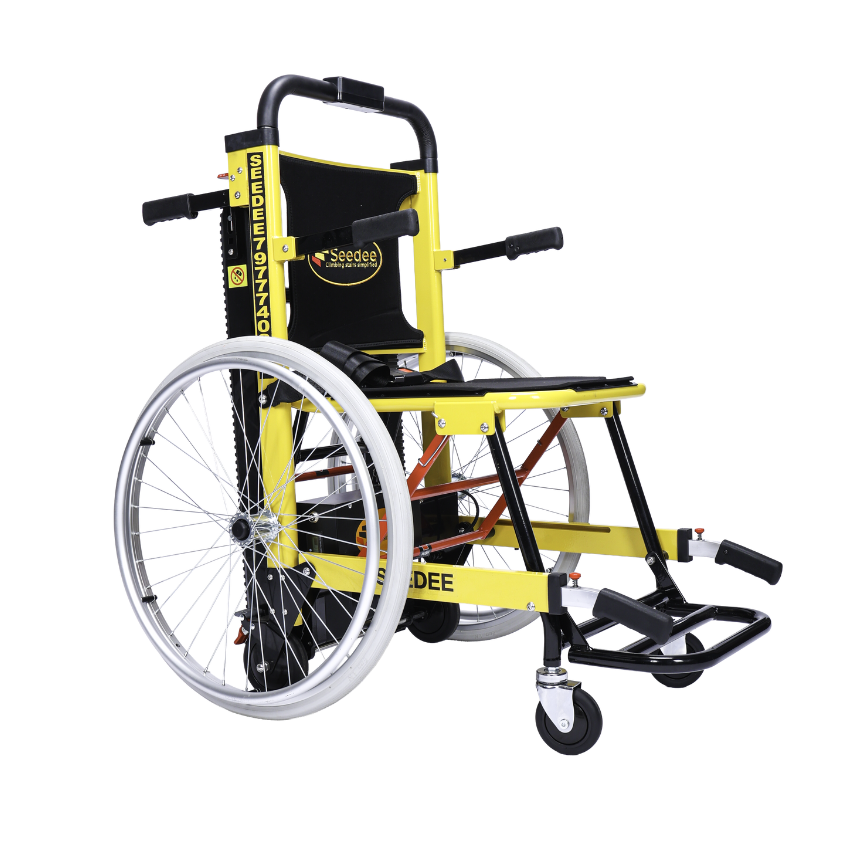
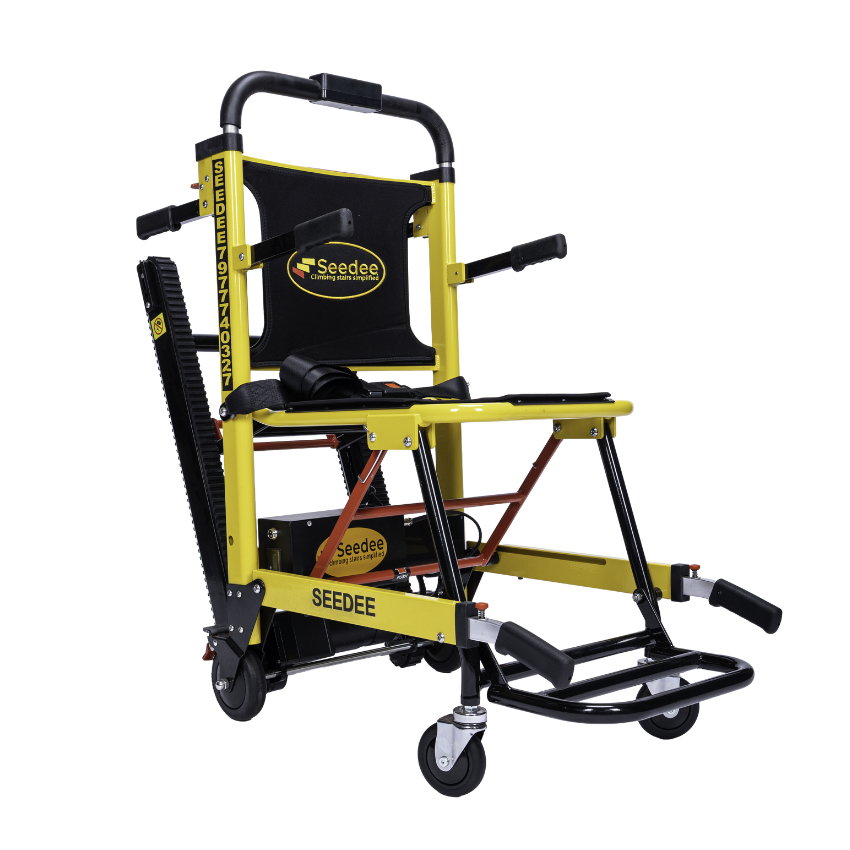
A stair-climbing wheelchair is designed for exactly this kind of situation. It allows a person to remain comfortably seated while a trained staff member guides the chair up or down the stairs. There is no lifting, no carrying, and no awkward moments on the steps.
For a bank branch, it offers some practical advantages:
- No construction needed. The chair works with the existing staircase, so there is no need for landlord approvals or civil work.
- Ready when needed. It can be kept in a corner of the branch and brought out within minutes when a customer arrives.
- Dignity for the customer. The customer stays seated and secure throughout, and reaches the counter like anyone else.
- Useful in emergencies too. The same chair can help staff move a person with limited mobility safely downstairs during an evacuation.
At Seedee, this is the problem we care about most: making sure that a flight of stairs never decides who gets to come in. Our stair-climbing wheelchairs are built for homes, offices, hospitals and public spaces where stairs are part of everyday life, and bank branches are a natural fit. If your branch is housed in a building where a ramp or lift is not feasible, the Seedee team can help you understand which chair would suit your premises and how your staff can use it with confidence.
Small steps that make a big difference
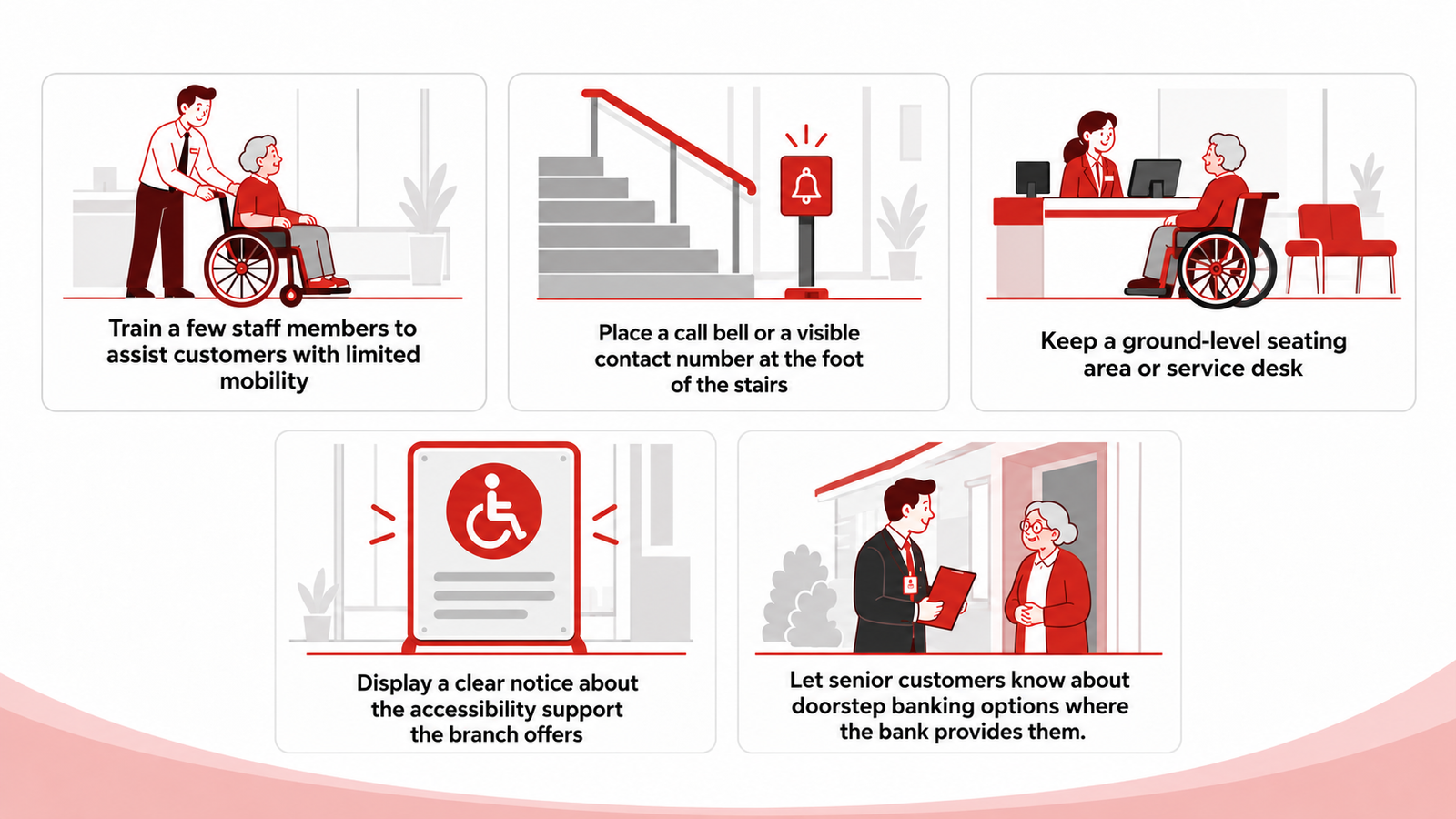
Equipment is only one part of an inclusive branch. A few simple practices can make older and mobility-impaired customers feel genuinely welcome:
- Train a few staff members to assist customers with limited mobility, patiently and respectfully.
- Place a call bell or a visible contact number at the foot of the stairs, so a customer can ask for help without having to climb first.
- Keep a ground-level seating area or service desk where routine tasks can be handled.
- Display a clear notice about the accessibility support the branch offers, as the RBI expects.
- Let senior customers know about doorstep banking options where the bank provides them.
A branch that welcomes everyone
Banking has always been built on trust, and trust begins at the door. When an elderly customer can walk, or be wheeled, into their branch without fear or embarrassment, they are far more likely to stay for years to come, and to bring their family with them.
Making a branch accessible does not always require rebuilding it. Sometimes, it simply requires the right support at the bottom of the stairs.
Is your branch is on an upper floor, or behind a flight of steps where a ramp or lift is not possible, speak with the Seedee team about a stair-climbing wheelchair that suits your premises.
Frequently asked questions
Q. Are bank branches in India required to be wheelchair accessible?
The RBI has directed banks to take appropriate steps, including ramps at branch entrances wherever feasible, so that wheelchair users and persons with disabilities can access branches and ATMs. Where a ramp is not practical, the reasons are to be recorded and displayed at the branch.
Q. What can a bank do if it cannot build a ramp or install a lift?
A stair-climbing wheelchair is a practical alternative. It works with the existing staircase, needs no construction, and allows trained staff to help customers up and down the stairs safely while they remain seated.
Q. How does a stair-climbing wheelchair work?
The customer sits securely in the chair while an attendant operates and guides it along the stairs. The chair is designed to move steadily from step to step, so the customer does not need to be lifted or carried.
Q. Who else in a branch can benefit from a stair-climbing wheelchair?
Besides elderly customers, it can help people recovering from injury or surgery, wheelchair users, and anyone with limited mobility. It can also support the safe evacuation of such persons during an emergency.